
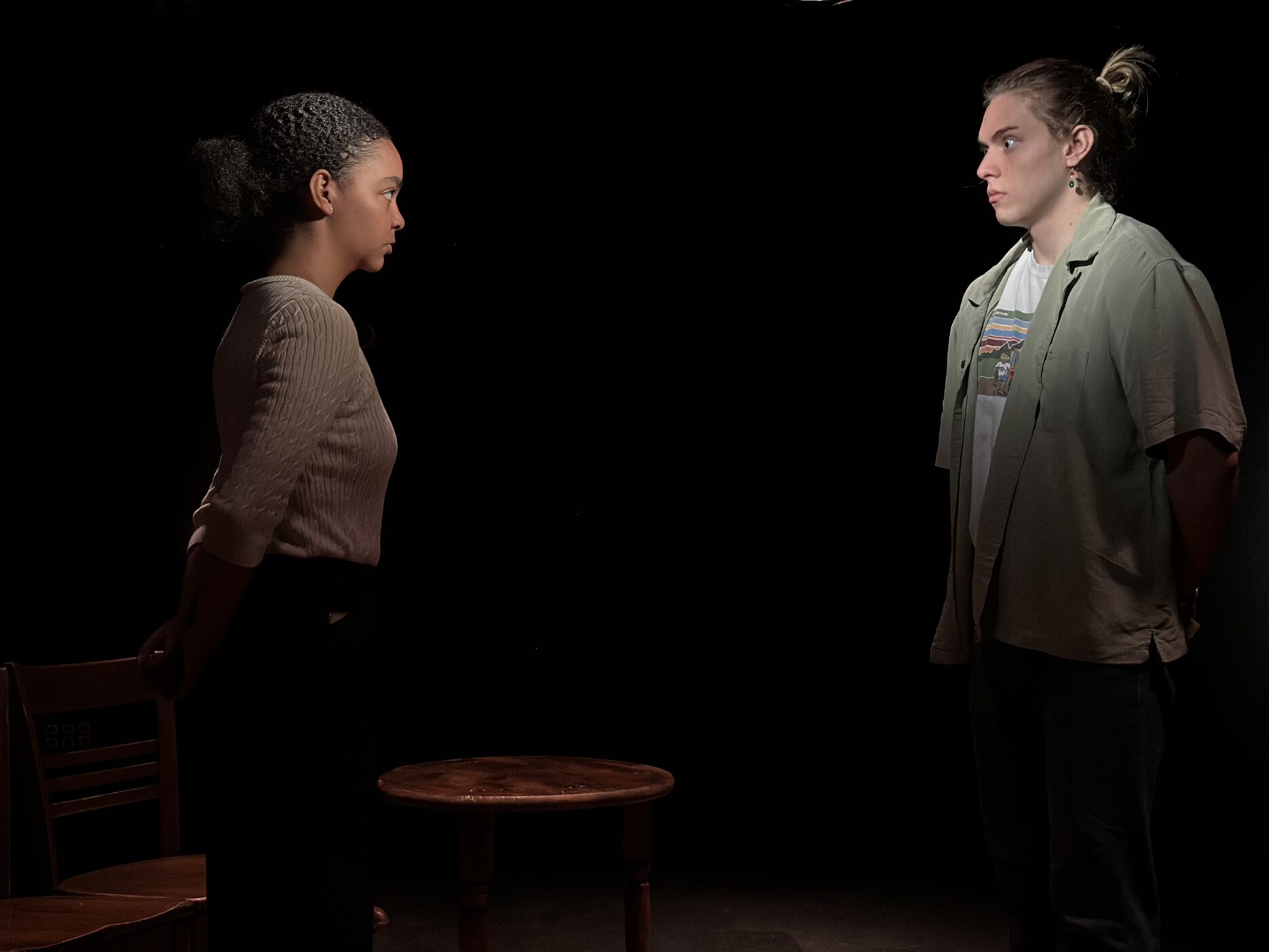
Attached is my final reflection where I discuss my strengths and areas of growth and how I engaged the entire directing process from pre-rehearsal research to closing night.
My first encounter with this process was the pre-rehearsal research. My experience with textual analysis was there for me during this process, but there is a unique skillset that I had to engage while working with the text from a directing perspective. One of my biggest strengths is my work ethic, specifically honoring the time commitment it takes to prepare and approaching every step of the process with excitement and enthusiasm. I knew that doing this work was important to set myself up for success, so I dove in headfirst and put myself through a rather rigorous mine of the text.
Lemons is a particularly challenging text because each unit is out of order with scenes early in the characters’ relationship occurring right before scenes that occur much later in time. On top of that, none of the scenes outright indicate when on the timeline they take place, so I was left with (sometimes incredibly subtle) clues as to when each scene takes place. I knew my first task before I could analyze the given circumstances was to develop a point of view on some chronological order. It took a huge amount of time to pick apart each scene and solve the puzzle of where they fall on the timeline. Some scenes are so unspecific and brief that placing them confidently felt impossible. Throughout this task, I grew worried that all this work would eat up a significant chunk of my limited time and that after I finished the timeline, it wouldn’t prove at all useful to me and I had wasted hours of research time and energy without getting anything done. At this point, I encountered one of my areas of growth: trusting myself and having confidence in my ability to do what’s necessary for this work.
After some time, I settled on a timeline that currently exists as an Excel workbook that also houses my working script and notes for myself. Ultimately, it proved incredibly useful because while I mined each scene to place it in time, I learned about the characters and how the circumstances of the Quietude Bill influences how they talk and what they say to each other. For instance, I picked up on how before the law takes effect, they speak in long monologues and use rambling metaphors to make the other understand them, and after Quietude takes effect, they speak in short phrases or single words that carry the weight of full sentences. Furthermore, some post-Quietude scenes begin with them announcing their word counts and others don’t, so any scene that starts with them announcing numbers takes place after the scene where Bernadette suggests they announce their counts.
Another challenge I faced that seems specific to this play was deciding where I could justify calling my research complete enough to enter the rehearsal room while also acknowledging that there will still be new discoveries. In this situation, I obviously had deadlines to meet and a short timeline to keep up with, so that was a great motivator in making that decision, but in other situations I’m not sure where I would have called myself ready. This, I think, boils down again to trusting that all the preparation I’ve done will be there for me so I can take it into the rehearsal room and see what in-the-moment discoveries emerge. Lemons is such a puzzle of a play that I was still discovering things about the text up until opening night. In one instance, there was a line late in the play that references a line from the very beginning, and I didn’t make the connection until one of the last rehearsals, but it was helpful to have that connection and put it to use because it helped the actor justify a tricky line.
The next step in this process was holding design meetings and letting other people enter the world of this play to help bring it to life. Another one of my strengths in this process was creating a spirit of collaboration and facilitating discussions that contributed to creating a unified product. During our meetings, I focused on listening to what the team brought to the table and turning our interpretation of the text into something that will show up in the designs and staging of the play. Something we wrestled with was whether the play is hopeful or hopeless. I think that the conclusion we came up with was that it’s not either of those things exclusively, but rather there are moments of both throughout the play, and that’s what makes it such a real, nuanced piece. By inviting them to bring their expertise to the table without being worried about fitting “my directorial vision”, I think our discussions were freer and uninhibited. I still feel very lucky that I had a great team of designers who were so eager to employ their skillsets. It was so helpful to have people whose only role in the process was one specific aspect so I could focus more of my attention to the actors without having to worry about the other aspects of the work.
Then, I held auditions. This part of the process for me was also nerve-wracking because I was still learning to trust myself, and I was anxious that I would make the wrong choices and set myself up for failure. However, looking back, I know that I should have trusted myself sooner because working with Wiley and Ariana made this process and the result the best it could possibly be.
After casting, scheduling rehearsals worried me because working with such a big project in a short span of time means that there is always the possibility of falling behind and having to play catchup. I think another one of my strengths that showed up for me in this process was my time management skills and preparation on a large scale. I built the rehearsal calendar after communicating with the actors about their conflicts and my own, and I planned tentative benchmarks for us to hit with every rehearsal with specific page numbers to work and days for full runs. Then, generally, we stuck to the calendar of staging and working without rushing to allow ourselves time for things to emerge. When we had rehearsal, we worked productively together and focused on the exchange of energy and justifying wants and destination as soon as possible so that they are clear right off the bat. Every day before rehearsal, I had my calendar ready to remind myself what we were going to work during that period. Even though the calendar changed at certain points to be realistic with our progress, having that all planned ahead of time helped me in the long run because I could anticipate what problems may emerge, and I had daily goals to make so I knew that we weren’t falling behind and scrambling to catch up towards the end.
On the other hand, one area that needed development early on was my preparation on the small-scale, especially in terms of preparing for staging rehearsals. During the first couple staging rehearsals, I thought I would be able to see what emerged blindly without pre-planning any staging. This was a horrible mistake. The rehearsals were slow, and we made little progress, and anything that we staged was muddled and confusing and hard for the actors to justify. At the end of the night, I left rehearsal stressed and discouraged from our lack of progress and unsatisfied with what we had done. I quickly realized that this wasn’t the way to go and invested some time into reading the pages we were scheduled to stage beforehand and taking note of destination, important lines, beat shifts, wants, and activities. I noticed an almost immediate change in the rehearsal room where things were easier to justify because I was much more prepared and aware of the demands of the text. I also left rehearsals more satisfied with the work we did that night! For the rest of the process, I invested time before each rehearsal in preparing myself more for the day’s work, and we were able to stay on schedule without compromising the quality of our investigation of wants, activities, etc.
Another struggle I faced was over-complicating some of the action to the point that it was hard to justify. For instance, some scenes took place in different locations, such as the living room, dining room, bedroom, the pet cemetery, and Bernadette’s car. Each location had a configuration of the set pieces, and between scenes, the actors would move them to the next configuration as a destination or activity that allowed them to stay in the scene while getting into the next moment. Sometimes, it was difficult to justify moving furniture to get into the next location while exchanging energy and earning what they’re after. Also, with moving furniture for a significant portion of the scenes, it was bound to get really confusing for the actors and uninteresting for the audience. The play is about the characters’ relationship to each other more than their relationship to the space, so I decided during the rehearsal process to cut some of the location changes and see how we could justify keeping more of the action in one location. This proved to be incredibly helpful for the actors in terms of playing full out and keeping a steady flow. Looking back, if we kept it the way it was with more moving furniture, the fluidity and momentum of the play would suffer. I think that if I was directing another play with slightly different demands, having a larger set of locations would have made more sense, but it made this text overcomplicated and harder to work with. I almost wonder if there is more we could have shaken loose in terms of transitioning between locations to make the action even simpler in order to focus on the characters’ relationships. Either way, I wish I invested a little more thought in how to convey place in the play before getting ahead of myself with all these overcomplications.
This part of the process also demonstrates one of my strengths: my ability to step back and notice small or large things to work on and being able to diagnose an issue and find a solution. Engaging this skillset was always incredibly exciting in rehearsals because when we were able to come up with a solution to the issues we faced, the results began developing at a rapid pace. This occurred for small things like reclarifying a character’s action in the moment to help the actors play an important moment more fully. The biggest, most overarching example I can think of occurred to me after we had a couple full run throughs before I had the chance to step back for a few days while I was out of town. I noticed that much of the action felt one note and that the actors were struggling to earn what they were after during the most tense, climactic arguments throughout the play. Also, having feedback from Marc after the designer run confirmed for me that it didn’t feel like they were much of a couple and that Oliver and Bernadette rather hated each other. I realized that throughout the staging and working rehearsals, we’d focused so heavily on the climactic that every other moment was full of the same actions and wants. Lemons is a story about a couple doing everything they can to hold on to each other and what they have because they love each other, and without those moments where they show how much they love and need each other, they can’t justify fighting each other to keep what they have or change something so they can be happy together.
So, during our last leg of rehearsals into tech rehearsals, we looked back at some scenes and recontextualized wants and allowed for the action to be uplifting, joyful, and supporting. Building that foundation in the early scenes of the play allowed the actors to earn the things they needed to fight for to keep their relationship together. Getting into our full tech runs with all this under our belts, something seemed to click into place and the play felt whole, nuanced, and so much more authentic. The thing I’m perhaps most proud of myself for accomplishing during this process was being able to diagnose this larger issue and remedying it. The wants of the characters felt so clear, the connection between the actors was authentic and developed, and since they had a renewed foundation and familiarity with the material, they were able to be present and discover new things and listen to each other all the way through closing night.
During tech rehearsals, the early work of the design team really paid off because everything seemed to just snap into place. We never felt rushed or behind or compromising on anything and were able to maximize our time together before the show opened on Monday. In the final runs, with everything under their belts, the actors managed to trim the runtime down from 95 minutes to 85 minutes or less by being specific about what they were seeking from the other and earning it and not having to justify moving furniture all the time just to make the action make sense!
Many things occurred to me while I watched the performances. The main thing was that there was a learning curve for understanding what was unfolding before them. I expected them to understand right away, but I think this was a naïve assumption because I’m so familiar with the text. Regardless of my expectations, I feel okay that the audience wasn’t immediately on board with what was happening because I think part of the journey of Lemons is the initial disorientation and urgently following each moment to understand it. I feel incredibly fortunate and delightfully surprised that throughout the run, audiences were invested in the plot beyond the obligatory investment of being a theatregoer. I could tell people related to and cared about the characters, and this is all due to the work that we did throughout the rehearsal process of discovering the nuances and subtleties of their moment-to-moment lives. I was also happy that the play didn’t grow stale after a certain point. The nature of the piece suggests some repetition, and I was nervous before opening night that audiences would lose interest by the end because of the repetition. I think if we had interrupted the action more to get between locations and disrupted the flow of the piece, it would have gotten stale by the end, but audiences on all three nights were absorbed and reactive all the way through the end.
In conclusion, this process was incredibly enlightening in terms of understanding the workload of a director and the necessary steps in the process, and I feel extremely lucky to be able to engage this process with as much trust and agency as I was given. I think my biggest strengths include my ability to approach the work with excitement and preparedness, my time management in terms of meeting deadlines and setting goals for myself and meeting them, my ability to be diagnostic and use my knowledge to problem solve at large and small scales, and my work with the actors to be specific about actions, destination, activities, and wants. My biggest areas of growth I encountered during this process include my tendency to overcomplicate rather than keep it simple, doubting myself and my ability to do the work, and in terms of staging or working in rehearsals, drawing focus to important moments instead of spending significant portions of time on less important moments.
After finishing this process, I feel more confident and eager than I have before in my ability to make a life out of this work while knowing that I have plenty of room for growth and development.


